At the Garage, we respect the innovators who find a way to make the machine run, even if they have to turn it upside down to do it. Elizabeth Cotten is the “Piedmont Queen” because she brought a gentle, rolling, and incredibly sophisticated sound out of the mountains of North Carolina and into the ears of the world—all by playing the guitar exactly the “wrong” way.
Born near Chapel Hill, North Carolina in the early 1890s, Elizabeth “Libba” Cotten was a self-taught, left-handed folk and blues guitarist whose upside-down “Cotten picking” style helped define Piedmont blues and the 1960s American folk revival. She wrote the classic song “Freight Train” as a child, disappeared into domestic work for decades, and then re-emerged in her 60s to influence generations of acoustic guitarists.
Who Elizabeth Cotten Was
- Elizabeth “Libba” Cotten (born near Chapel Hill, North Carolina) was a left-handed guitarist, banjo player, singer, and songwriter who became an icon of Piedmont blues and American folk music.
- Growing up in the Jim Crow South, she taught herself to play on borrowed instruments long before affordable guitars or “lefty” models existed in rural Carolina.
- Her song “Freight Train,” written when she was about 11 or 12, became a folk standard covered by artists around the world.
The Upside-Down “Cotten Picking” Style
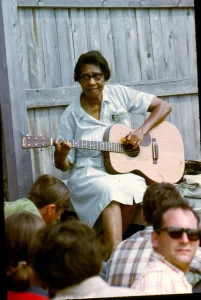
- Cotten was left-handed, but she learned on right-handed instruments. Instead of restringing, she flipped the guitar upside down and played it as-is.
- That meant the bass strings were on the bottom and the treble strings were on top, completely reversing normal guitar mechanics.
- Her thumb took the lead, playing high-register melodies on the “bottom” strings, while her index finger handled the alternating bass patterns on the “top” strings.
- This inverted approach created a rolling, syncopated groove that feels like a ragtime piano: delicate, rhythmically complex, and harmonically rich.
- When you hear “Freight Train,” you’re hearing classic Piedmont fingerstyle guitar—forward motion that mimics the sound of the rails and the gentle push of a train in the night.
Gear and Tone
- Libba Cotten wasn’t a modern “gear nerd,” but she knew what worked for her music.
- She is most often associated with Martin acoustic guitars, especially small- and mid-bodied models like the Martin 00-18 and D-18.
- These guitars gave her the woody, clear, and balanced tone her intricate fingerpicking needed to cut through without ever feeling harsh.
- No pedals, no stacks, no studio trickery—her “effects” were her left hand, her thumb, and a flipped guitar.
Piedmont Blues and Her Influence
- Piedmont blues is a lighter, more melodic cousin to Delta blues, blending ragtime, country, gospel, and African American string band traditions.
- Instead of heavy, thumping rhythms, Piedmont fingerpicking dances: alternating bass lines, syncopated melodies, and chord voicings that sound like two instruments at once.
- Elizabeth Cotten became a bridge between early 20th-century Piedmont blues and the 1960s folk revival, carrying that sound into coffeehouses, festivals, and records.
- Folk and blues players—from Bob Dylan to Taj Mahal to today’s young pickers—owe a huge debt to her approach, whether they know it or not.
- She proved that the blues doesn’t have to shout to hit you in the chest; it can be quiet, intricate, and deeply soulful.
Rediscovery, Folk Revival, and Legacy
- Cotten spent decades working as a domestic worker and raising a family, with her music mostly pushed to the background.
- While working in the home of the Seeger family (Pete Seeger and his relatives), her playing was “rediscovered,” and the folk world finally woke up to her genius.
- She began performing and recording publicly in her 60s, bringing her gentle voice and upside-down guitar style to a new generation of listeners.
- In her later years, she toured widely, often performing seated with her Martin guitar and that unmistakable rolling right hand.
- She eventually earned a Grammy for the album Elizabeth Cotten Live!—a late but well-deserved recognition of a lifetime of innovation and soul.
Why She’s the “Quiet Power” of The Blues Garage
- At thebluesgarage.com, Elizabeth Cotten is our ultimate “custom build”: a musician who took the hand she was dealt, flipped the instrument over, and rewired the rules.
- She reminds us there is no “correct” way to play the blues; there’s only your way, your hands, your story.
- She showed that melody can be as powerful as rhythm, and that a simple tune written by a child can grow into a global anthem.
- To us, she’s the Queen of the Piedmont, the master of the upside-down style, and the quiet heartbeat of acoustic blues—a living blueprint for anyone who feels unconventional, late to the game, or just stubborn enough to flip the guitar over and see what happens.